
Bitcoin slipped below $80,000 on Monday as a renewed oil shock and stronger-than-expected U.S. jobs data pushed investors to reassess the outlook for interest rates.
The cryptocurrency traded around $79,800 at around 13:00 CEST, after briefly rising above $82,000 last week. The pullback came as higher energy prices added to inflation concerns just as Friday’s U.S. employment report strengthened the case for keeping monetary policy restrictive.
Oil shock adds to inflation pressure
Brent crude traded near $96 a barrel on Monday and had reached as high as $97.93 after fresh U.S.-Iran clashes involving oil tankers and military vessels around the Strait of Hormuz. The renewed maritime escalation followed an already sharp move in energy markets, with Brent gaining roughly 8% and U.S. West Texas Intermediate close to 10% during the previous week.
The Strait remains one of the world’s most important energy transit routes. Tanker traffic has fallen sharply in recent months, while Iran said on Monday that it plans to introduce a new restricted shipping zone in the Gulf. The immediate market effect has been a renewed geopolitical premium in crude.
Higher energy costs complicate the inflation outlook for central banks. Oil can feed into headline inflation, transport costs and corporate input prices, reducing the room for policymakers to ease and increasing the risk that interest rates remain higher for longer.
That matters for Bitcoin because tighter financial conditions can weigh on demand for risk assets when higher expected policy rates lift bond yields and increase the relative appeal of cash and fixed-income instruments. The relationship is not mechanical, but crypto has become increasingly sensitive to changes in the macro rates backdrop.
Fed decision remains finely balanced
Friday’s U.S. jobs report strengthened the case for tighter policy. Nonfarm payroll employment rose by 162,000 in August while the unemployment rate remained at 4.1%, according to the U.S. Bureau of Labor Statistics. Average hourly earnings increased 0.3% during the month and were 3.1% higher than a year earlier.
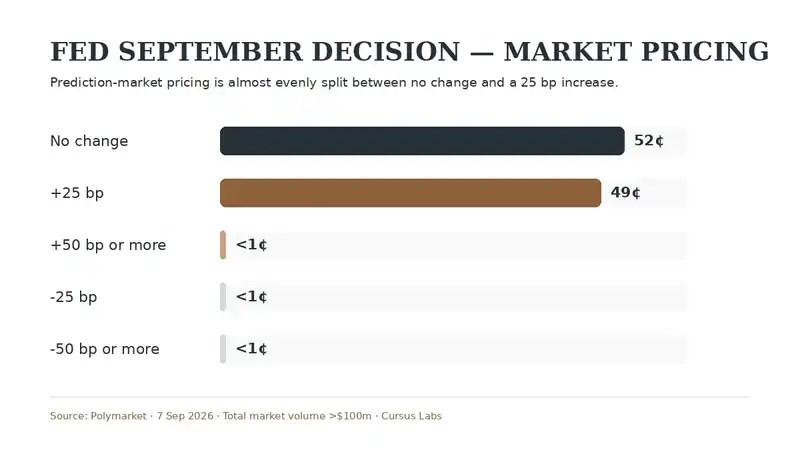
Prediction-market pricing nevertheless shows that the September decision remains close. At around 13:00 CEST on Monday, Polymarket contracts traded at 52 cents for no change and 49 cents for a 25-basis-point increase, with more than $100 million in total market volume. All other outcomes were priced below one cent.
Bitcoin had traded above $82,000 before the employment release but moved back below $80,000 as the rates outlook hardened. The reaction illustrates an increasingly important feature of crypto markets: stronger economic data can support risk appetite, but it can also be negative for asset prices when it raises the probability of tighter monetary policy.
Inflation data is the next test
The next major U.S. catalysts arrive later this week. The Producer Price Index for August is scheduled for Thursday, September 10, followed by the Consumer Price Index on Friday, September 11, according to the BLS release calendar.
The European Central Bank is also due to announce its next monetary-policy decision on Thursday. Together, the releases will give markets a clearer view of whether the latest energy shock is reinforcing inflation pressure ahead of the Federal Reserve’s September 15–16 meeting.
For Bitcoin, the near-term question is therefore less about a crypto-specific catalyst than whether inflation and interest-rate expectations continue to move against risk assets. Hotter inflation data would strengthen the case for additional monetary tightening, while softer readings could ease pressure on yields and improve the macro backdrop for crypto.
 Cursus Labs